When IRS Guidance Isn’t Law: What Aroeste Means for Green Card Holders, Treaty Residency, and Form 8854
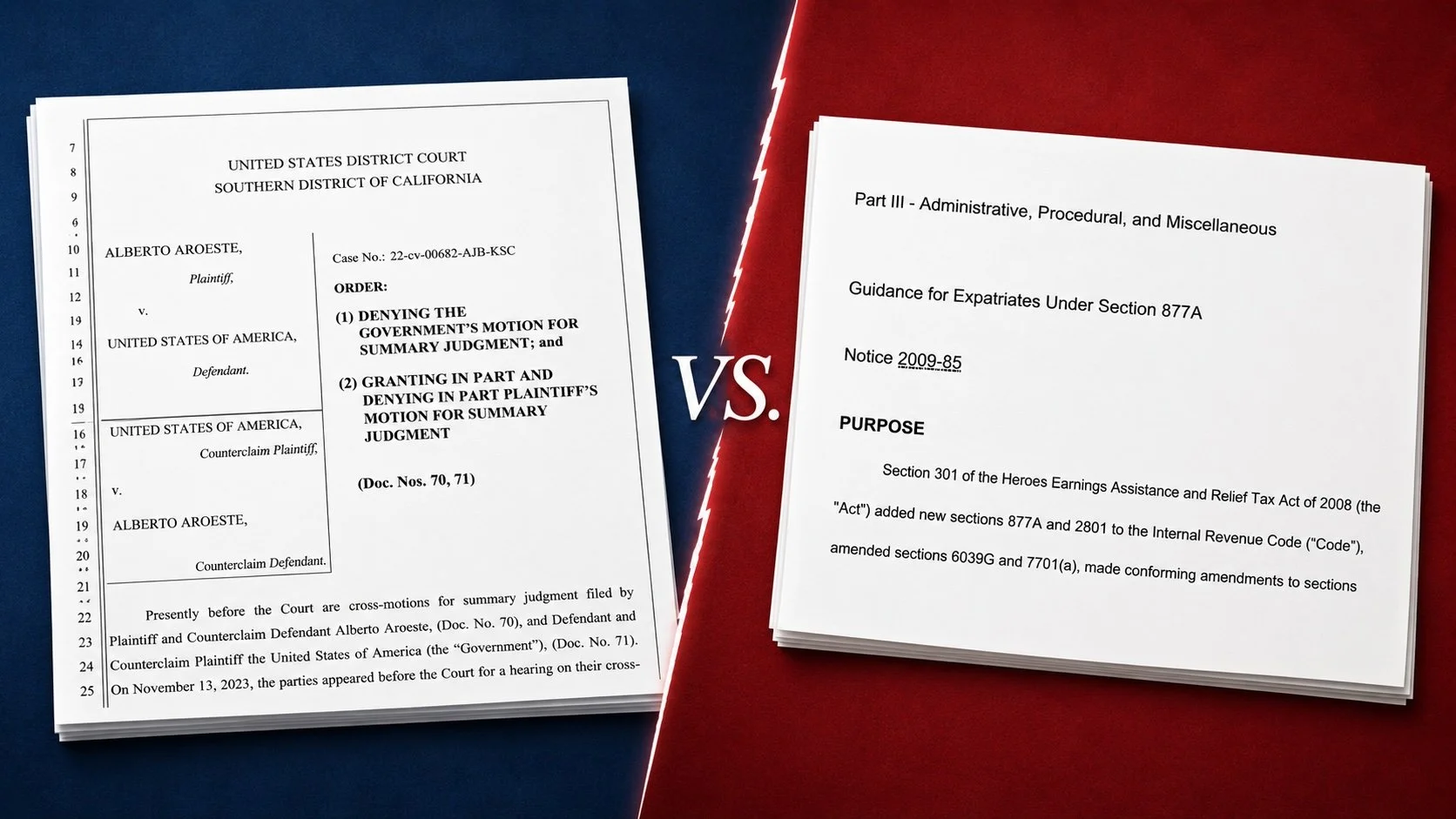
In Aroeste v. United States, a federal district court held that IRS Notice 2009-85 does not carry the force of law, and that a green card holder who claimed non-residency under the U.S.-Mexico income tax treaty did not forfeit that treaty position by failing to file Form 8854. The decision confirms that substantive tax consequences must come from the Internal Revenue Code and properly promulgated regulations, not from IRS notices, form instructions, or administrative practice. For long-term green card holders and anyone planning an expatriation, the case reframes what filing failures actually cost.
For many individuals with ties to more than one country, U.S. tax residency is often treated as a question of form. Hold a green card, and the answer seems obvious. File the right forms, and the outcome follows. IRS guidance is read as if it were binding law.
The Aroeste decision challenges that entire framework.
Key takeaways:
• IRS notices are not binding law unless issued through Administrative Procedure Act notice-and-comment rulemaking.
• A late Form 8833 treaty disclosure triggers the statutory penalty under section 6712, not forfeiture of treaty benefits.
• Form 8854 is not a statutory precondition to claiming treaty-based non-residency under section 7701(b)(6).
• A treaty tie-breaker can end U.S. tax residency even where the green card is never formally surrendered.
• The statute does not say that a late Form 8854 alone converts an otherwise compliant taxpayer into a covered expatriate.
• The ruling is not binding precedent on any court. Both sides dismissed their Ninth Circuit appeals with prejudice in May 2024, and two parallel Tax Court deficiency cases remain pending.
Beneath what appears to be a narrow dispute over penalties lies a more consequential question: who defines tax status: the statute and treaty, or the IRS through forms and informal guidance? The court’s answer places the emphasis squarely on legal authority rather than administrative expectation.
For globally mobile individuals, that distinction is not merely technical. It is strategic.
What Did the Court Decide in Aroeste v. United States?
The court held that the IRS could not use Notice 2009-85 to impose Form 8854 as a condition of treaty-based non-residency, and that the taxpayer’s late treaty disclosure did not forfeit his treaty benefits.
Aroeste began as a dispute over FBAR penalties, but the federal district court addressed two questions with far broader implications: whether the IRS can impose substantive obligations through informal guidance, and whether failing to file Form 8854 undermines a taxpayer’s ability to rely on a treaty to establish non-residency.
The court’s analysis makes two points clear. IRS guidance does not carry the force of law unless it has been promulgated through proper procedures, and statutory and treaty-based rights cannot be overridden by requirements derived solely from nonbinding administrative materials.
Who Was Alberto Aroeste and Why Did the IRS Assess FBAR Penalties?
Alberto Aroeste was a Mexican citizen who had lived in Mexico his entire life while holding a U.S. green card since the 1980s. His was not a typical expatriation case. He and his wife owned a condominium in Florida but used it only occasionally. He consistently filed tax returns in Mexico as a resident there.
Critically, he never formally surrendered his green card.
Instead, for the years at issue, he filed U.S. tax returns claiming non-resident status under the tie-breaker provisions of the U.S.–Mexico income tax treaty. The Internal Revenue Service (“IRS”) disagreed and imposed significant FBAR penalties, arguing that he remained a U.S. tax resident.
What followed was not simply a treaty interpretation dispute. It became a test of how far the IRS can go in enforcing compliance positions that are not grounded in statute or properly issued regulations.
The court ultimately sided with the taxpayer. It accepted that he could be treated as a resident of Mexico under the treaty and therefore not subject to the FBAR penalties asserted by the government.
Is IRS Notice 2009-85 Binding Law?
No. Notice 2009-85 was never promulgated through notice-and-comment rulemaking under the Administrative Procedure Act, so it cannot impose substantive requirements beyond those in the Internal Revenue Code and its regulations. A central issue in the case was the IRS’s reliance on Notice 2009-85. The government argued that the taxpayer’s failure to comply with requirements outlined in that notice, including filing Form 8854, undermined his ability to claim treaty benefits.
The court rejected that position.
The reasoning turned on a fundamental principle of administrative law. Treasury regulations that carry the force of law must be issued in accordance with the Administrative Procedure Act, 5 U.S.C. section 553, which requires notice-and-comment rulemaking. Informal guidance, including IRS notices, does not go through that process and therefore does not have the same legal effect.
Notice 2009-85, while informative, had not been promulgated as a binding regulation. As a result, the court concluded that it could not impose additional substantive requirements on taxpayers beyond what is provided in the Internal Revenue Code (“Code”) and applicable regulations.[3]
This distinction is often overlooked in practice. Taxpayers and advisors frequently treat IRS guidance as if it were binding law. Aroeste is a reminder that the hierarchy matters. The implication is not that IRS guidance is irrelevant. It is that such guidance cannot, standing alone, create new legal obligations or condition statutory rights where Congress has not done so.
Does a Late Form 8833 Disclosure Forfeit Treaty Benefits?
No. Section 6114 requires disclosure of a treaty-based return position, and section 6712 prescribes a monetary penalty for failing to disclose. Because Congress specified that consequence, the court held it could not be expanded into forfeiture of the underlying treaty rights. The government also argued that the taxpayer’s failure to properly disclose his treaty-based position should prevent him from relying on the treaty.
Here, the court drew an important distinction.
Under the Code, taxpayers claiming treaty benefits are required to disclose that position, generally through Form 8833. The Code also specifies the penalty for failing to comply with that requirement.
The court held that the taxpayer’s late disclosure did not result in forfeiture of treaty benefits. Instead, Congress had already determined the consequence of noncompliance, and that consequence was a monetary penalty, not the loss of substantive treaty rights.
This aspect of the decision is critical. Filing obligations matter, but where the statute prescribes a specific consequence for noncompliance, the IRS cannot expand that consequence to include the loss of underlying rights.
Is Form 8854 Required to Claim Treaty-Based Non-Residency?
No — not where the taxpayer relies on a treaty tie-breaker rather than formal expatriation. The government’s position placed weight on the taxpayer’s failure to file Form 8854, arguing that this failure meant he had not properly notified the IRS of his change in status.
Form 8854 is tied to formal expatriation under section 877A. Aroeste never formally expatriated; his position was that he ceased to be treated as a U.S. resident under section 7701(b)(6) because a treaty tie-breaker treated him as a resident of Mexico.
That argument reflects a common assumption in practice: that failure to file a required form necessarily invalidates the underlying position.
The court rejected that reasoning in this context.
Form 8854 is associated with formal expatriation under section 877A and is generally used by individuals who terminate U.S. tax residency through statutory expatriation mechanisms, including long-term green card holders who formally relinquish status.
Aroeste, however, did not formally expatriate. His position was that he ceased to be treated as a U.S. tax resident under section 7701(b)(6) because he was treated as a resident of Mexico under an applicable treaty and did not waive those treaty benefits.
The government’s attempt to require Form 8854 in this context relied on Notice 2009-85. Since that notice was not binding under the Administrative Procedure Act, the court concluded that the IRS could not rely on Notice 2009-85 to impose Form 8854 as a prerequisite for recognizing treaty-based non-residency.
The result was not that filing obligations are irrelevant. Rather, it was that the IRS could not derive a substantive requirement from nonbinding guidance where the statute itself did not impose that requirement. Informal administrative guidance cannot transform a reporting omission into the loss of treaty-based rights where the Code itself does not prescribe that consequence.
Does a Late Form 8854 Automatically Make You a Covered Expatriate?
Aroeste also highlights a separate issue that frequently arises in expatriation planning: whether a late Form 8854 filing automatically causes an individual to become a covered expatriate.
The statute does not say so. The inquiry is whether the taxpayer was in fact compliant with U.S. tax obligations during the relevant five-year period, not whether the certifying form arrived on time.
Under section 877(a)(2)(C), incorporated into section 877A, covered expatriate status may arise where an individual fails to certify, under penalty of perjury, compliance with U.S. tax obligations for the five taxable years preceding expatriation or fails to provide the required evidence of that compliance. The statute, however, does not expressly state that a late Form 8854 filing automatically converts an otherwise compliant taxpayer into a covered expatriate.
That distinction matters. Form 8854 is the mechanism used to make the certification and disclose expatriation information, but the statutory inquiry ultimately focuses on whether the taxpayer was in fact compliant with U.S. tax obligations during the relevant five-year period. Where the taxpayer was actually compliant, a late filing may create exposure to reporting penalties, but that is analytically different from concluding that covered expatriate status automatically applies solely because the form was filed after the due date.
This matters most for long-term green card holders who relinquished residency years ago without knowing Form 8854 existed. In those cases the government’s position has leaned heavily on Notice 2009-85. Aroeste reinforces that informal guidance cannot independently create substantive consequences that Congress did not clearly impose in the statute itself.
None of this means that Form 8854 should be treated casually. It remains a critical expatriation filing, and failure to file can create meaningful penalty exposure and procedural complications. But Aroeste underscores a broader principle: statutory status should ultimately be determined by the statute enacted by Congress, not by administrative assumptions embedded in nonbinding guidance.
Aroeste does not eliminate statutory penalties that Congress expressly authorized. Rather, the decision limits the IRS’s ability to expand those consequences through informal administrative guidance that lacks the force of law.
Can a Treaty Tie-Breaker End U.S. Tax Residency Without Surrendering a Green Card?
Yes. Aroeste never filed Form I-407 and never formally expatriated, yet the court recognized that he had ceased to be treated as a U.S. tax resident because the U.S.-Mexico treaty tie-breaker resolved his dual residence in favor of Mexico. One of the more subtle aspects of the decision is how the taxpayer’s status changed without any formal surrender of his green card.
The mechanism was the treaty tie-breaker.
Under Article 4 of the U.S.-Mexico income tax treaty, an individual treated as a resident of both countries is assigned to one of them by applying the following tests in order:
1. Permanent home available to the individual
2. Center of vital interests, where personal and economic relations are closer
3. Habitual abode
4. Nationality
5. Mutual agreement of the competent authorities
A test is reached only if the preceding one fails to resolve the question.
By satisfying that framework and complying with the statutory requirements, the taxpayer effectively shifted his tax residency to Mexico, and was no longer treated as a lawful permanent resident for U.S. tax purposes, even though his immigration status remained unchanged.
For U.S. tax purposes, an individual’s residency can turn on where life is actually centered rather than on immigration status alone. A green card that remains valid for immigration purposes does not by itself settle the tax question when a treaty tie-breaker applies.
Is Aroeste Binding Precedent?
The district court’s ruling in Aroeste v. United States, No. 22-cv-00682 (S.D. Cal. Nov. 20, 2023), while final between the parties, is not binding precedent on anyone: a federal district court decision binds no other court, and because both sides voluntarily dismissed their Ninth Circuit appeals with prejudice in May 2024, there will never be an appellate ruling in the case.
Nor does the decision bind the Tax Court, which follows only the law of the circuit to which an appeal lies, never district court rulings.
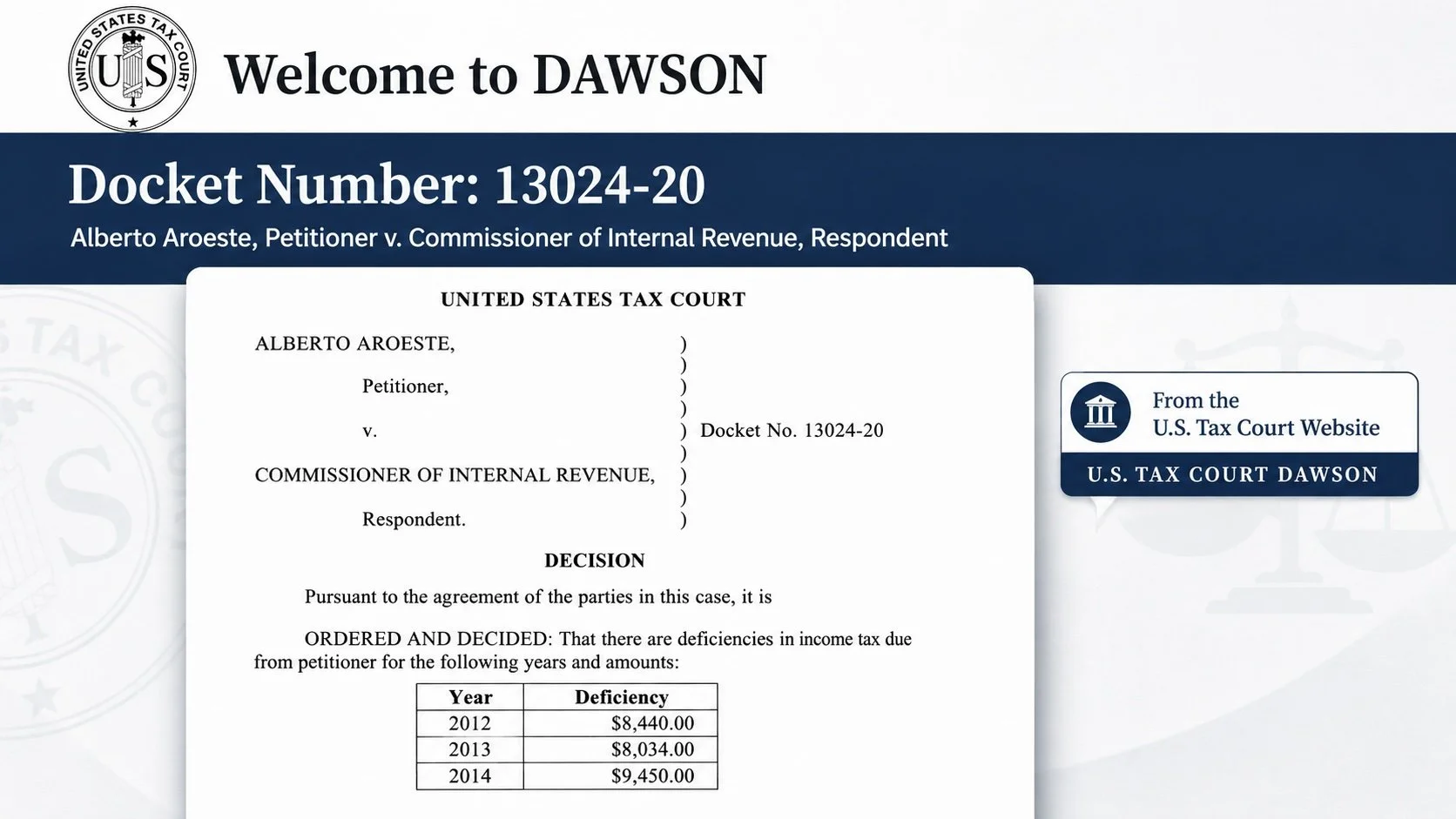
That is why the two parallel deficiency cases still pending in the Tax Court, Aroeste v. Commissioner, Docket Nos. 13024-20 and 15372-20, are the ones to watch: if the Tax Court reaches the merits, they are poised to produce the first precedential ruling on whether a retroactively asserted Article 4 tie-breaker position terminates lawful permanent resident status under section 7701(b)(6) for prior years.
Why Aroeste Matters for Cross-Border Tax and Expatriation Planning
Aroeste is not simply a treaty residency case. At its core, it is a case about legal authority.
The decision reinforces a principle that is easy to overlook in cross-border tax planning: IRS guidance does not become binding law merely because it appears in a notice, form instruction, or administrative practice. Where Congress has defined the governing statutory framework, the IRS cannot expand substantive consequences through informal guidance that was never promulgated through proper procedures.
That principle mattered in Aroeste because the government attempted to use Notice 2009-85 and Form 8854 filing expectations to undermine treaty-based non-residency. The court rejected that approach and instead focused on what the statute and treaty actually required.
The case also highlights a separate but equally important point in expatriation planning. The statutory certification test under sections 877 and 877A focuses on whether the taxpayer can certify compliance with U.S. tax obligations for the relevant five-year period. The statute does not expressly provide that a late Form 8854 filing, by itself, automatically creates covered expatriate status. Aroeste reinforces that those consequences must ultimately be grounded in the statute enacted by Congress, not in assumptions derived from informal administrative guidance.
Reporting obligations still matter. Form 8854 remains an important filing, and failing to file it creates real statutory penalty exposure and procedural friction. What Aroeste establishes is narrower and more useful: where Congress has prescribed a consequence, the IRS cannot enlarge it through guidance that never went through rulemaking. For taxpayers with cross-border lives and treaty-based positions, that distinction can materially affect both compliance strategy and long-term planning.
Frequently Asked Questions
Does Aroeste mean green card holders can stop filing U.S. tax returns?
No. A green card holder remains a U.S. tax resident under section 7701(b) unless a treaty tie-breaker applies and the position is properly disclosed on Form 8833. Aroeste narrowed what the IRS can require, not who is subject to U.S. tax.
Is Aroeste binding precedent nationwide?
No. A federal district court decision binds no other court — not other districts, not other judges in the same district, and not even the same judge in a later case. Both sides voluntarily dismissed their Ninth Circuit appeals with prejudice in May 2024, so there will never be an appellate ruling in the case. The decision also does not bind the Tax Court, which under Golsen follows only the law of the circuit to which an appeal lies. Its reasoning on the Administrative Procedure Act rests on principles of general application, but it carries persuasive weight only.
What should a long-term green card holder who never filed Form 8854 do now?
Determine the date residency actually terminated, confirm whether tax compliance for the five preceding years can be certified, and assess whether the relief procedures for certain former citizens or a delinquent filing approach fits the facts. The analysis is fact-specific and should be done before any filing is submitted.
Does a treaty tie-breaker position affect FBAR obligations?
It can. Aroeste succeeded in defeating FBAR penalties because he was treated as a resident of Mexico under the treaty for the years at issue. FBAR filing obligations turn on U.S. person status, which is why the residency determination controlled the penalty outcome.
Does claiming a treaty tie-breaker trigger expatriation tax?
Not by itself for most individuals. Under section 7701(b)(6), a long-term resident who claims treaty non-residency is treated as having relinquished lawful permanent resident status for tax purposes, which can bring section 877A into play. Whether that produces covered expatriate status depends on the net worth, tax liability, and certification tests.
What are the pending Aroeste Tax Court cases?
Aroeste v. Commissioner, Docket Nos. 13024-20 and 15372-20, are parallel deficiency cases still pending in the U.S. Tax Court. If the court reaches the merits, they are positioned to produce the first precedential ruling on whether a retroactively asserted Article 4 tie-breaker position terminates lawful permanent resident status under section 7701(b)(6) for prior years. Because Tax Court precedential opinions govern cases arising in every state, such a ruling would carry weight nationally in a way the district court decision cannot.